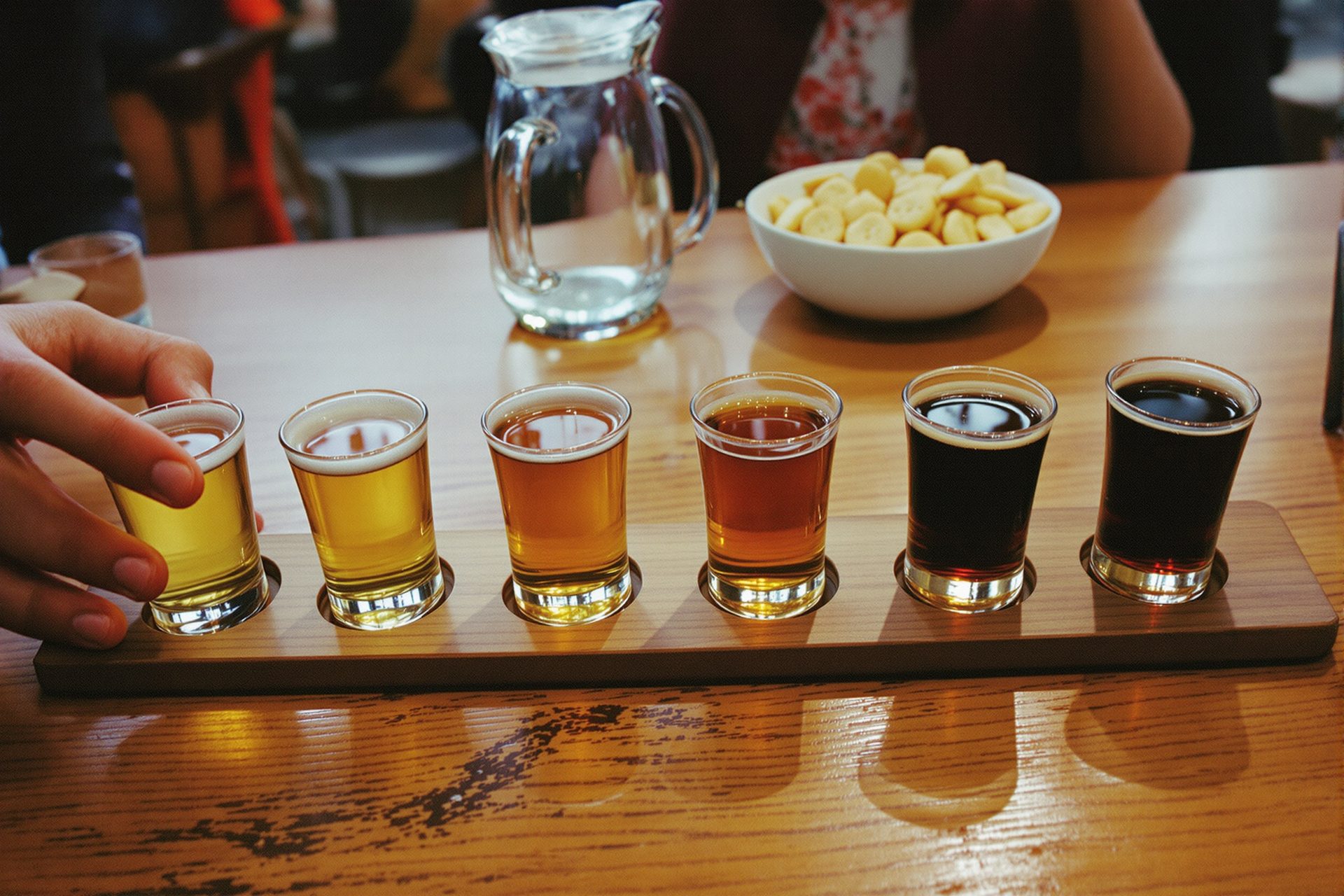
How to build a beer tasting flight
The point of fixing the format is that you stop designing nights. Four styles on a named theme, one alcohol-free pour, one wildcard, poured light to dark. Six glasses. Decide it once and every future meeting becomes a shopping trip instead of a project.
This is not a connoisseur's format. It is a format built so that somebody who knows nothing about beer can run a tasting that the person who knows the most at the table still enjoys, which is a harder problem and a more useful one.
Why six, and why three ounces
Six pours at three to four ounces is eighteen to twenty-four ounces across an evening. Call it a pint and a half over two hours, with food on the table. That is a tasting rather than a session, and the distinction matters: the format only works if everybody can still taste the sixth beer and still get home.
Seven or eight pours sounds more generous and is worse. The palate is done by the sixth, so the extra beers are wasted on people who can no longer tell them apart, and it is always the last one, the interesting one, that pays for it.
Put a dump bucket on the table. Tipping out half a taste is not an insult to the beer, it is the mechanism that makes six pours a tasting instead of six drinks.
Pour light to dark, low to high
One rule, and it is the rule that most first tastings break. Light to dark, low alcohol to high. A 4.5% pilsner tasted after a 10% imperial stout tastes like water, and the person who brought the pilsner will hear about it for a month.
When color and strength disagree, follow strength. A pale barleywine goes after a dark mild, whatever the glasses look like.
The wildcard goes last, and it goes out unpoured and unnamed until it is its turn. That means picking one that can survive the final slot: strong, dark, smoked or sour. A delicate pale ale in position six is a beer nobody will taste.
The arithmetic, once
A 16 oz bottle pours five honest three-ounce tastes. Four, if you are being generous, and you will be generous. So:
- Twelve people means three bottles of each beer.
- Six beers therefore means eighteen bottles.
- The alcohol-free beer is one of the six, so buy that as a four-pack and you have a spare.
On money: either everybody runs their own tab, or everybody drops $12 to $15 into a pot and one person buys the flight. At twelve people that is $144 to $180, and eighteen craft singles at $4 to $9 each come to $72 to $162. Comfortable at the low end, tight at the top, and worth checking against your own shop's prices before you announce a number.
Never a rounds system. Rounds quietly ask everybody to drink at the same speed, which is the one thing this format exists to avoid, and the reason it appears as its own line in the ten house rules.
The alcohol-free pour is one of the six
This is the detail that changes the character of the club, and it costs nothing.
One alcohol-free beer sits in the flight, not beside it. It is poured first, scored like the rest, and named on the card like the rest. Nobody explains why they are drinking it and nobody is asked.
The reason to build it into the format rather than offer it on request is that a request requires somebody to announce a thing about themselves to a table of near-strangers. Somebody is not drinking tonight, or this year, or ever, and the version of the club where that is a normal glass in a normal flight is a club they can come to. The stouts and IPAs coming out of the alcohol-free breweries are good enough to score honestly, and if the venue stocks nothing, bring a four-pack yourself.
Five themes, ten weeks, no deliberation
Each theme names four styles and a wildcard. The alcohol-free beer makes six, and it is poured first.
- Hop spectrum. German pilsner, hazy pale ale, West Coast IPA, double IPA. Wildcard: a black IPA, dark but still hops.
- The dark half. Brown ale, dry Irish stout, robust porter, imperial stout. Wildcard: a Bamberg rauchbier.
- Belgium, briefly. Witbier, saison, dubbel, quadrupel. Wildcard: a gueuze, for the arguments.
- Sour, gently. Berliner weisse, gose, fruited kettle sour, Flanders red. Wildcard: a barrel-aged wild ale.
- Lager, seriously. Czech pale lager, Munich helles, Vienna lager, schwarzbier. Wildcard: a Baltic porter at 9%.
Run them in that order, one per meeting, and you have ten weeks of flights decided in a single sitting. Substitute freely for whatever your shops actually stock, because a theme nobody can source is not a theme.
What the wildcard is for
The wildcard is the beer nobody at the table would have bought on their own. That is its entire job.
It hands the quiet person something to have an opinion about, which is a real problem to solve: at a table of twelve, two or three people will not say much about a beer they merely liked. A rauchbier or a gueuze is not a beer you merely like. It is also, reliably, the pour people are still texting about on Friday.
Choose it last and say nothing about it until every glass is filled.
Let the bottle shop build it
A bottle shop with staff will assemble the entire flight if you hand them the theme and a number. Say it plainly at the counter: six beers on this theme, three bottles of each, under $150, and make one of the six a good alcohol-free one.
It takes them ten minutes, it costs nothing extra, and they usually turn up something you would have walked straight past. This is the part of the format that makes "you do not need to know anything about beer" true rather than encouraging.
Four lines per beer, on a notebook page
Write down four things per beer. It takes fifteen seconds and it turns "that was nice" into an actual conversation, which is the point of the table.
- Beer and brewery. So you can find it again. Half the value of a tasting is the shopping list you walk out with.
- One word. The first honest word, before anybody else speaks. "Bandaid" and "church" are more useful than "nice".
- A score out of ten. Yours, not the beer's. A 6 is a good beer. Keep 10 for the once-a-year one and it stays worth something.
- Buy again, yes or no. The only mark that predicts anything. A 9 you would never buy again is telling you something a 9 alone cannot.
Nobody says a number out loud until all six are tasted. Then go round the table once, one beer at a time, thirty seconds each. Average them if you like, though the average has never once been the interesting number.
Say this on the first night and mean it: there is no right answer, and "I did not like it" is a complete sentence. A table where people are worried about being wrong goes quiet by the third pour, which is the same failure as a book club where only the people who finished feel entitled to speak.
Do not build a form. Five lines, six times, down one side of a notebook page. Nobody has ever filled in a form at a bar.
Where the flight sits in the night
The flight is about ninety minutes of a three-hour evening, and the rest of it is the club. The room you pour it in is doing at least as much work, which is why the venue standard gets more attention than the beer list does, and why the route standard for a run club reads almost identically: pick the thing that lets people talk to each other, and let the activity be the excuse.
Questions
- How many beers should be in a tasting flight?
- Six, at three to four ounces each. That is eighteen to twenty-four ounces across a whole evening, or roughly a pint and a half. Fewer than five and the night is short. More than seven and the palate is gone before the last pour, which wastes the beer you were most looking forward to.
- What order should you pour a tasting flight in?
- Light to dark, low alcohol to high. A 4.5% pilsner tasted after a 10% imperial stout tastes like water. When color and strength disagree, follow strength. The wildcard goes last, unpoured and unnamed until then, so choose one that can survive the final slot: strong, dark, smoked or sour, never a delicate pale.
- How much beer do you need for a tasting with twelve people?
- A 16 oz bottle pours five honest three-ounce tastes, and four if you are generous, which you will be. Twelve people therefore means three bottles of each beer, so a six-beer flight is eighteen bottles. Buy the alcohol-free one as a four-pack and you have a spare.
- Should a beer tasting include a non-alcoholic beer?
- Yes, and it belongs in the flight rather than beside it: poured first, scored like the rest, named on the card like the rest. Somebody at the table is not drinking, on that night or ever, and a flight of five plus a courtesy bottle asks them to explain themselves. The alcohol-free stouts and IPAs are good enough now to score honestly.
- How do you score beers at a tasting?
- Four lines per beer, written on a notebook page: the beer and brewery, one word, a score out of ten, and whether you would buy it again. It takes fifteen seconds. Buy-again is the only mark that predicts anything, and nobody says a number out loud until all six have been tasted. Do not build a form. Nobody has ever filled in a form at a bar.